

Newborn Metabolic Screening Market to Reach US$590.3 Bn by 2033 at 8.9% CAGR, Says Persistence Market Resaerch
newborn metabolic screening market
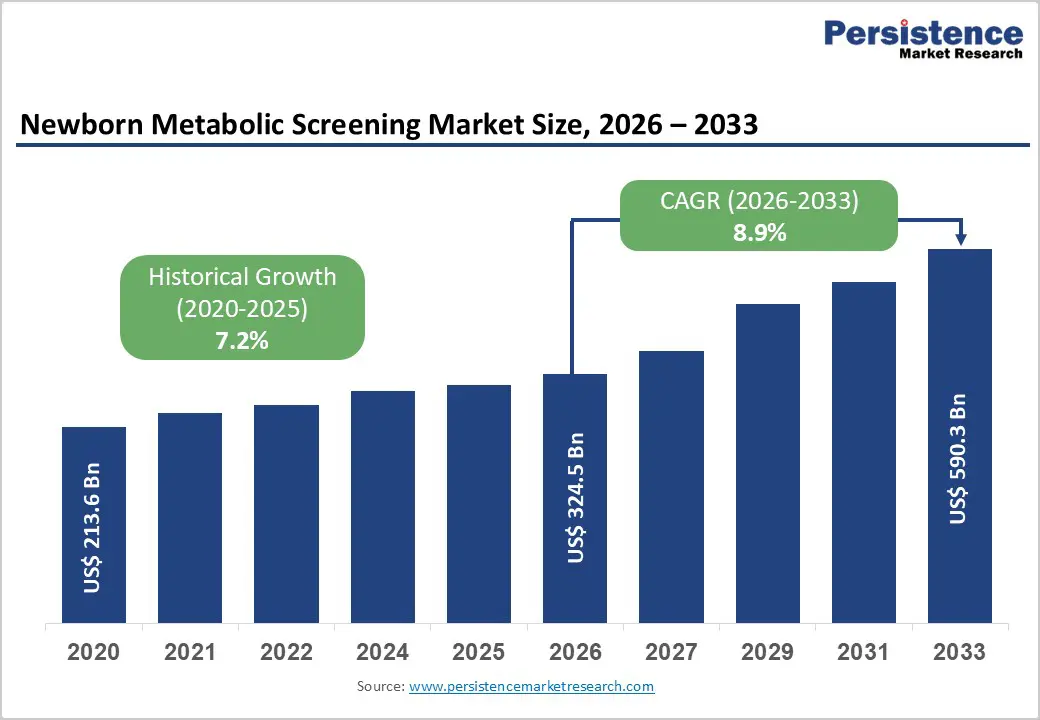
LONDON, UNITED KINGDOM, February 12, 2026 /EINPresswire.com/ -- The global newborn metabolic screening market is entering a sustained growth phase, driven by rising awareness of congenital metabolic disorders and rapid advancements in diagnostic technologies. Industry projections indicate the market will be valued at US$ 324.5 billion in 2026 and is expected to reach US$ 590.3 billion by 2033, expanding at a compound annual growth rate (CAGR) of 8.9% during the forecast period. Historical growth between 2020 and 2025 stood at 7.2%, reflecting steady expansion supported by government mandates and technological innovation.
Newborn metabolic screening plays a critical role in identifying inherited metabolic and genetic disorders shortly after birth, enabling early intervention that can prevent lifelong disability or mortality. According to the World Health Organization, approximately 40 million babies worldwide undergo newborn screening each year, with early diagnosis facilitating timely treatment for nearly 40,000 infants annually.
Download Your Free Sample & Explore Key Insights: https://www.persistencemarketresearch.com/samples/31998
Market Drivers Accelerate Expansion
One of the primary growth drivers is the increasing prevalence of congenital metabolic disorders. Research indicates that approximately 1 in 33 babies in the United States is born with congenital birth defects, with metabolic disorders accounting for a notable share. Conditions such as phenylketonuria (PKU), maple syrup urine disease (MSUD), methylmalonic acidemia, and sickle cell disease require early detection to prevent severe complications.
Technological innovation has significantly enhanced screening efficiency and accuracy. Tandem mass spectrometry (MS/MS) and flow-injection analysis MS/MS (FIA-MS/MS) enable simultaneous analysis of multiple biomarkers from a single dried blood spot sample. These technologies improve sensitivity and specificity while reducing false positives. The integration of next-generation sequencing (NGS) further expands screening panels, allowing detection of more than 50 metabolic and genetic disorders through a single test. Healthcare institutions worldwide are investing in advanced diagnostic platforms to improve operational efficiency and expand screening capabilities.
Regional Outlook Highlights Strong Momentum
North America continues to dominate the global newborn metabolic screening market, accounting for approximately 38% of total market share in 2025. The region benefits from well-established healthcare infrastructure, universal screening mandates, and standardized screening panels across all U.S. states. Regulatory oversight and program guidance from agencies such as the Centers for Disease Control and Prevention and the Health Resources and Services Administration support nationwide program consistency and quality assurance.
In contrast, Asia Pacific represents the fastest-growing regional market, projected to register a CAGR of 11–13% between 2026 and 2033. The region accounts for nearly half of global births, creating immense untapped potential. Countries including China, India, Indonesia, Bangladesh, and Pakistan are expanding newborn screening initiatives. China alone operates around 150 newborn screening laboratories, with more than 100 utilizing tandem mass spectrometry technology. Government-backed healthcare modernization programs and expanding public health budgets are expected to drive further adoption.
Get Custom Insights Designed for Your Business: https://www.persistencemarketresearch.com/request-customization/31998
Segment Insights
By test type, sickle cell disease screening led the market in 2025, capturing approximately 24% share. The high prevalence of hemoglobinopathies and established regulatory mandates contribute to its dominance. Screening is widely included in recommended panels across developed healthcare systems due to the proven clinical benefits of early diagnosis.
Tyrosinemia screening is emerging as the fastest-growing test segment, supported by expanding screening panels and increasing recognition of early treatment advantages. Improved detection technologies and greater clinical awareness are contributing to this rapid growth trajectory.
Dried blood spot (DBS) sampling remains the universal standard for newborn metabolic screening. This method involves collecting small volumes of capillary blood via heel prick and placing samples on specialized filter paper cards. DBS samples offer long-term stability, minimal invasiveness, and logistical convenience, making them ideal for centralized laboratory analysis and high-throughput mass spectrometry testing.
Diagnostic laboratories represent the dominant end-user segment, reflecting centralized screening models and the need for specialized analytical infrastructure. These laboratories process large volumes of specimens while maintaining stringent quality assurance standards. Hospitals and specialty clinics support screening efforts but often rely on centralized laboratories for confirmatory testing.
Market Challenges Persist
Despite promising growth prospects, several challenges hinder full market penetration. High initial capital investment remains a significant barrier, particularly in developing economies. Establishing screening laboratories requires advanced instrumentation, skilled personnel, and robust quality control systems. Many low- and middle-income countries face limited laboratory capacity and insufficient funding for universal screening programs.
Regulatory variability across countries further complicates expansion. Screening panels differ widely, with developed nations screening for 29 to 40 conditions, while many emerging markets test for fewer than 10 disorders. Limited public awareness and high rates of home births in certain regions also restrict program implementation.
Competitive Landscape and Future Outlook
The competitive landscape is moderately consolidated, characterized by technological innovation and strategic collaborations. Companies are focusing on expanding test panels, integrating automation, and improving turnaround times. Partnerships with government agencies and healthcare institutions remain central to market positioning.
Checkout Now & Download Complete Market Report: https://www.persistencemarketresearch.com/checkout/31998
Market Segmentation
Test Type
Galactosemia
Sickle Cell Disease
Cystic Fibrosis
Toxoplasmosis
Phenylketonuria (PKU)
Methylmalonic Acidemia
Maple Syrup Urine Disease (MSUD)
Tyrosinemia
Sample Type
Dried Blood Spot (DBS) Sampling
End User
Diagnostic Laboratories
Specialty Clinics
Hospitals
Regions
North America
Europe
East Asia
South Asia and Oceania
Latin America
Middle East and Africa
Recent developments underscore the sector’s momentum. In August 2025, Abu Dhabi launched a comprehensive newborn genetic screening initiative offering whole genome sequencing to detect more than 815 treatable childhood conditions, including metabolic and rare genetic disorders. Such initiatives reflect a broader global shift toward integrated genomic screening within national healthcare systems.
With expanding government mandates, advancing diagnostic technologies, and rising global awareness, the newborn metabolic screening market is positioned for sustained and transformative growth through 2033.
Read Related Reports:
Hepatitis C Treatment Market: Global hepatitis C treatment market will rise from US$9.8 Bn in 2025 to US$12.7 Bn by 2032 at 3.8% CAGR, driven by high-efficacy DAAs offering 95%+ cure rates.
Cutaneous and Systemic Leishmaniasis Market: The Cutaneous & Systemic Leishmaniasis market, valued at US$376.4 million in 2025, is projected to reach US$459.8 million by 2032, growing at a 2.9% CAGR.
Persistence Market Research
Persistence Market Research Pvt Ltd
+1 646-878-6329
email us here
Visit us on social media:
LinkedIn
Instagram
Facebook
YouTube
X
Legal Disclaimer:
EIN Presswire provides this news content "as is" without warranty of any kind. We do not accept any responsibility or liability for the accuracy, content, images, videos, licenses, completeness, legality, or reliability of the information contained in this article. If you have any complaints or copyright issues related to this article, kindly contact the author above.
